Taman Sari Yogyakarta: The Story Behind the Sultan’s Former Royal Retreat

Taman Sari Yogyakarta: The Story Behind the Sultan’s Former Royal Retreat

Taman Sari is far more than a historical photo stop. Built in the mid-18th century as a royal pleasure garden and secret fortress for the Sultanate of Yogyakarta, it offers a rare glimpse into Javanese royal life, defensive ingenuity, and architectural synthesis.

Today, it remains a living heritage site where historic royal structures interstate with Kampung Taman, a thriving local artisan neighborhood. Whether you are a history enthusiast, photography lover, or casual traveler, here is everything you need to know to plan your visit.

What Is Taman Sari Yogyakarta?

The name Taman Sari translates literally from Javanese as "beautiful garden" (taman meaning garden, and sari meaning beautiful or flowers). The English moniker "Water Castle" arose among European visitors and colonial writers who observed its fortified stone gates, thick perimeter walls, and extensive artificial lake system that once surrounded the central royal pavilions.

Today, the core preserved monuments (most notably the Umbul Pasiraman bathing pools and the circular Sumur Gumuling structure) stand as one of Yogyakarta's most significant cultural heritage landmarks.

Why Was Taman Sari Built?

To understand Taman Sari, one must look at the geopolitical climate of Central Java in the mid-18th century. Following the Treaty of Giyanti in 1755, the Mataram Sultanate was divided, leading to the foundation of the Yogyakarta Sultanate under Sri Sultan Hamengkubuwono I. As the founder of the new dynasty, the Sultan sought to establish a capital that embodied Javanese royal legitimacy, spiritual authority, and tactical security.

Historical accounts suggest that Taman Sari was commissioned not merely as a decorative pleasure park, but as a multi-functional estate serving several distinct purposes:

  1. Royal Leisure and Rest: The complex provided a private sanctuary away from formal court obligations, where the Sultan, his family, and members of the royal household could rest, bathe, and enjoy landscaped gardens.
  2. Spiritual Meditation and Solitude: Built with quiet chambers and secluded island structures, the site accommodated royal spiritual practices, fasting, and meditation (semedi) aligned with traditional Javanese mystical philosophy.
  3. Defensive and Tactical Capability: Built shortly after years of regional conflict, the estate incorporated thick masonry walls, elevated watch posts, gated courtyards, and subterranean passages. In times of crisis, parts of the complex could be flooded or secured to function as a hidden fortress.
  4. Architectural Symbolism: Designed by a combination of Javanese royal architects and an engineer known in local lore as Demak Tegalisah (believed by some historians to be of Portuguese or Dutch origin), the estate synthesized Javanese Hindu-Buddhist spatial cosmology with European brickwork and Islamic geometric design.

What Was Taman Sari Like in Its Prime?

Today’s visitor sees isolated stone monuments woven into the residential fabric of Kampung Taman. However, in its prime during the late 18th century, Taman Sari was a continuous, 10-hectare hydraulic landscape where water was the defining architectural element.

The complex was historically divided into four primary zones:

  1. The Artificial Lake (Segaran) System: A vast body of water to the west anchored by Pulo Kenanga (Kenanga Island). Royal wooden boats navigated the lake, carrying the Sultan and guests to an elevated island villa that appeared to float on the water's surface.
  2. The Central Bathing Complex (Pasiraman Umbul Binangun): An enclosed courtyard containing three distinct swimming pools, decorative fountains, changing rooms, and a central three-story observation tower (Panggung).
  3. The Southern Retreat (Pasarean Ledok Sari): A secluded private area featuring sleeping quarters, meditation rooms, an underground kitchen, and formal fruit orchards.
  4. The Complex of Bridges, Gates, and Tunnels: A network of brickwork gateways (Gapura), elevated walkways, and underground passages (Tajug) that connected the Kraton to the outer defense perimeters.

A catastrophic earthquake in 1867 collapsed many of the elevated roofs and breached the water channels, draining the artificial lakes. Over the decades that followed, local residents built homes within the dried lakebed, giving rise to today's vibrant Kampung Taman neighborhood.

What to See at Taman Sari Yogyakarta

Taman Sari Yogyakarta: The Story Behind the Sultan’s Former Royal Retreat - Ekaputra

Rather than a single static building, exploring Taman Sari involves walking through interconnected open-air courtyards, arched gateways, and subterranean chambers.

The Royal Bathing Pools (Umbul Pasiraman)

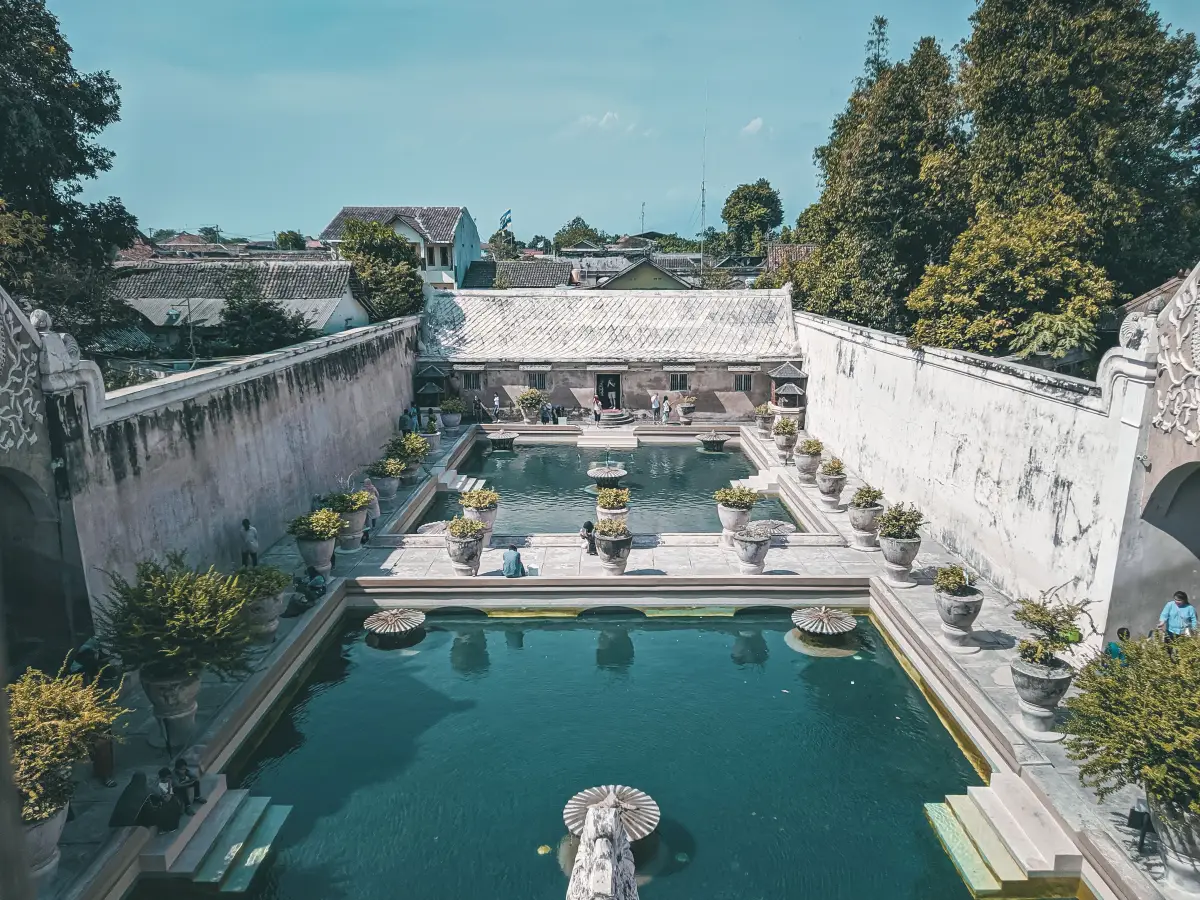
The central bathing area, known officially as Umbul Pasiraman or Umbul Binangun, is the most completely restored section of the estate. Enclosed by high plaster walls, the courtyard is divided into three distinct pools filled with clear, turquoise water fed by dragon-headed fountains:

  1. Umbul Muncar & Umbul Kumpul: The two larger outer pools designated for the Sultan's concubines and royal children.
  2. Umbul Binangun: A private, enclosed pool located behind the central tower, reserved exclusively for the Sultan and his primary consort.
  3. The Central Tower (Panggung): Positioned between the pools, this three-story tower served as the Sultan's private observatory over the bathing grounds.

Sumur Gumuling (The Underground Structure)

Located a short walk through subterranean brick tunnels, Sumur Gumuling is one of the most distinctive architectural heritage sites in Central Java.

Sumur Gumuling is a two-story circular underground building that historically functioned as a secret mosque (masjid bawah tanah). Its architecture features a central open-air circular skylight beneath which five raised stone staircases converge over a central well. These five staircases symbolically represent the five pillars of Islam.

Because traditional electronic speakers did not exist in the 18th century, the thick, windowless circular walls were engineered to provide natural acoustic resonance, allowing the imam’s voice to echo clearly through the surrounding prayer niches during services.

If you want to preserve the structural integrity of Sumur Gumuling, local heritage authorities occasionally manage visitor flow or restrict access to the inner staircases during restoration assessments. Check current access notices at the ticket counter upon arrival.

Underground Passages (Tajug)

Connecting Sumur Gumuling to the wider estate is a series of subterranean tunnels built from thick brickwork and volcanic ash mortar. Historically, these passages allowed the Sultan and royal attendants to move securely between the Kraton, the meditation chambers, and the outer defense perimeters without being observed from above. Today, walking through these cool, atmospheric tunnels offers relief from the tropical heat outside.

Gates and Surviving Architectural Details

As you navigate the complex, pay close attention to the stone gateways and decorative relief carvings:

  1. Gapura Hageng: The historic western main gate, adorned with intricate relief carvings depicting floral motifs, stylized birds, and Javanese nagas (mythical serpents). The carvings form a Javanese chronogram (Sengkalan), encoding the construction date (1684 Javanese calendar, equivalent to 1758 CE).
  2. Gapura Panggung: The eastern entrance gate, featuring elevated platform rooms where royal musicians (gamelan players) historically performed to welcome arriving guests.

The Stories and Myths Around Taman Sari

Because Taman Sari served as a private royal retreat, it has long generated local folklore and romanticized storytelling. To understand the site deeply, it is helpful to distinguish documented history from popular tourism legends.

AspectPopular Tourism LegendHistorical & Architectural Context
The Bathing PoolsLegends claim the Sultan stood atop the tower and threw a flower into the pool below; whichever concubine caught it was chosen for the day.While the Sultan did observe the grounds from the tower, the complex was primarily an organized royal residential zone with strict court etiquette, changing rooms, and ceremonial bathing routines.
Secret Escape TunnelsFolk stories claim the underground tunnels extended miles beneath Yogyakarta all the way to the Indian Ocean (Pantai Selatan) to meet the mythical sea goddess Nyai Roro Kidul.Archaeological surveys show the tunnels were tactical passages connecting the Kraton, Sumur Gumuling, and outer defensive walls—not multi-mile subterranean highways to the coast.
Underground Mosque AcousticsLocal lore attributes the echo inside Sumur Gumuling to mystical spiritual energy.The sound resonance is an intentional feat of Javanese architectural acoustics, using thick circular masonry and domed geometry to amplify the human voice.

Where Is Taman Sari Yogyakarta?

Taman Sari is located in the Patehan district within the historic walled Kraton precinct (Kota Cagar Budaya) of central Yogyakarta, Special Region of Yogyakarta, Central Java, Indonesia.

It sits approximately:

  1. 1.0 km south of the main Kraton Yogyakarta (Sultan's Palace).
  2. 2.0 km south of Malioboro Street (Jalan Malioboro).
  3. 500 meters west of Alun-Alun Kidul (the Southern City Square).

How to Get to Taman Sari

Because of its central location within Yogyakarta, reaching Taman Sari is straightforward via several transport modes:

  1. On Foot from Kraton: If you are already exploring the Sultan's Palace, you can walk west along Jalan Rotowijayan or south through Jalan Taman for roughly 10–15 minutes.
  2. By Traditional Becak (Cycle Rickshaw): Taking a traditional becak (either pedal-powered or motorized) from Malioboro or the Kraton area costs approximately IDR 20,000–35,000. Always agree on the fare prior to boarding.
  3. By Ride-Hailing (Grab / Gojek): Motorbike taxis (ojek) and cars can be ordered via the Grab or Gojek mobile apps. Set the drop-off point to Plasa Ngasem or Gerbang Utama Taman Sari.
  4. By TransJogja Bus: Take the TransJogja bus service to the Halte Ngasem or Halte Alun-Alun Utara stop, followed by a short 5-to-10-minute walk.

Taman Sari Yogyakarta Opening Hours and Entrance Fee

Note: Factual details such as entrance rates and operating schedules are subject to periodic changes by the Yogyakarta Cultural Office (Dinas Kebudayaan). It is advisable to confirm details locally before visiting.

ParameterDetails / Official Information
Official AddressJl. Taman Sari No. 42, Patehan, Keraton, Kota Yogyakarta, DI Yogyakarta 55132
Opening HoursOpen daily from 09:00 AM to 03:00 PM (WIB)
Domestic Visitor Ticket~IDR 15,000 per person
Foreign Visitor Ticket~IDR 25,000 per person
Professional Camera Fee~IDR 3,000 (applies to DSLR / mirrorless cameras)
Local Community Guide~IDR 30,000 – 50,000 (optional fee paid directly to local guide)

How Long Do You Need at Taman Sari?

Depending on your travel style and interest in historical architecture, consider these three visit scenarios:

1. Quick Stop (45–60 Minutes)

  1. Best For: Travelers with limited time who are combining multiple central Yogyakarta attractions in a single morning.
  2. Coverage: Walk through the main entrance, explore the Umbul Pasiraman bathing pools, view the central tower exterior, and take photos around Gapura Hageng.

2. Standard Visit (1.5 Hours)

  1. Best For: Most first-time visitors seeking a thorough overview of the site.
  2. Coverage: Explore the bathing pools, walk through the subterranean tunnels, view Sumur Gumuling, visit the elevated ruins of Pulo Kenanga, and take a brief stroll through Kampung Taman.

3. Slow Cultural Visit (2.5+ Hours)

  1. Best For: Photography enthusiasts, architecture lovers, and travelers interested in local art.
  2. Coverage: Full historical tour with an official local guide, detailed photography of masonry reliefs, visiting local Batik Tulis workshops in Kampung Taman, and stopping for coffee at an alleyway cafe.

What Is the Best Time to Visit Taman Sari?

  1. Best Time of Day: 09:00 AM (Right at Opening). Arriving early allows you to explore the central bathing complex under soft morning light before midday heat sets in and tour groups arrive around 10:30 AM.
  2. Best Days of the Week: Weekdays (Tuesday through Thursday) experience significantly lower visitor density than weekends or national Indonesian holidays.
  3. Weather Considerations: The main bathing pools and ruined gateways are open-air. During the tropical rainy season (November to March), carry a compact umbrella or raincoat for sudden afternoon downpours.

Is Taman Sari Worth Visiting?

Taman Sari is widely considered one of the most rewarding cultural stops in Yogyakarta, provided you approach it with the right context.

Taman Sari is definitely worth visiting if you:

  1. Appreciate historical architecture: The blend of Javanese spatial philosophy, European masonry, and hydraulic engineering offers rich material for exploration.
  2. Enjoy atmospheric photography: The contrast between turquoise pool water, aged whitewashed walls, and subterranean arched staircases creates exceptional visual compositions.
  3. Are exploring central Yogyakarta: Its close proximity to the Kraton, Sonobudoyo Museum, and Alun-Alun Kidul makes it an easy addition to a one-day city itinerary.
  4. Enjoy living community heritage: Walking between the historical monuments takes you directly through Kampung Taman, where local families run traditional batik workshops, puppet studios, and home cafes.

You might keep your visit brief or manage expectations if you:

  1. Expect an intact, modern palace: Much of the original 10-hectare lake complex no longer exists, having been replaced by residential neighborhoods over the past century.
  2. Require full mobility accessibility: The historic complex features uneven stone cobblestones, narrow doorways, and steep subterranean staircases that present challenges for wheelchair users or strollers.

Taman Sari’s value lies not in flawless preservation, but in its survival as a living ruin. The fragments that remain allow travelers to step back in time and reconstruct the quiet grandeur of Javanese royal life inside 18th-century Yogyakarta.

Nihay Ridani
Ditulis oleh

Nihay Ridani

Penulis · Pemikir · Burung Hantu Malam

Travel is my way of unveiling the story behind every destination. I love exploring local culture, food, hidden gems, and everyday experiences, and sharing them with others to make discovering Indonesia easier and more meaningful.

Tag: Trip
Bagikan: WhatsApp Facebook X
logo
logo

We’re Number One Travel Adventure Company

It is a long established fact that a reader will be distracted the readable content of a page when looking at layout the point of using lorem the is Ipsum less normal distribution of letters.

Contact Us