メインナビゲーション
Taman Sari is far more than a historical photo stop. Built in the mid-18th century as a royal pleasure garden and secret fortress for the Sultanate of Yogyakarta, it offers a rare glimpse into Javanese royal life, defensive ingenuity, and architectural synthesis.
Today, it remains a living heritage site where historic royal structures interstate with Kampung Taman, a thriving local artisan neighborhood. Whether you are a history enthusiast, photography lover, or casual traveler, here is everything you need to know to plan your visit.
The name Taman Sari translates literally from Javanese as "beautiful garden" (taman meaning garden, and sari meaning beautiful or flowers). The English moniker "Water Castle" arose among European visitors and colonial writers who observed its fortified stone gates, thick perimeter walls, and extensive artificial lake system that once surrounded the central royal pavilions.
Today, the core preserved monuments (most notably the Umbul Pasiraman bathing pools and the circular Sumur Gumuling structure) stand as one of Yogyakarta's most significant cultural heritage landmarks.
To understand Taman Sari, one must look at the geopolitical climate of Central Java in the mid-18th century. Following the Treaty of Giyanti in 1755, the Mataram Sultanate was divided, leading to the foundation of the Yogyakarta Sultanate under Sri Sultan Hamengkubuwono I. As the founder of the new dynasty, the Sultan sought to establish a capital that embodied Javanese royal legitimacy, spiritual authority, and tactical security.
Historical accounts suggest that Taman Sari was commissioned not merely as a decorative pleasure park, but as a multi-functional estate serving several distinct purposes:
Today’s visitor sees isolated stone monuments woven into the residential fabric of Kampung Taman. However, in its prime during the late 18th century, Taman Sari was a continuous, 10-hectare hydraulic landscape where water was the defining architectural element.
The complex was historically divided into four primary zones:
A catastrophic earthquake in 1867 collapsed many of the elevated roofs and breached the water channels, draining the artificial lakes. Over the decades that followed, local residents built homes within the dried lakebed, giving rise to today's vibrant Kampung Taman neighborhood.

Rather than a single static building, exploring Taman Sari involves walking through interconnected open-air courtyards, arched gateways, and subterranean chambers.
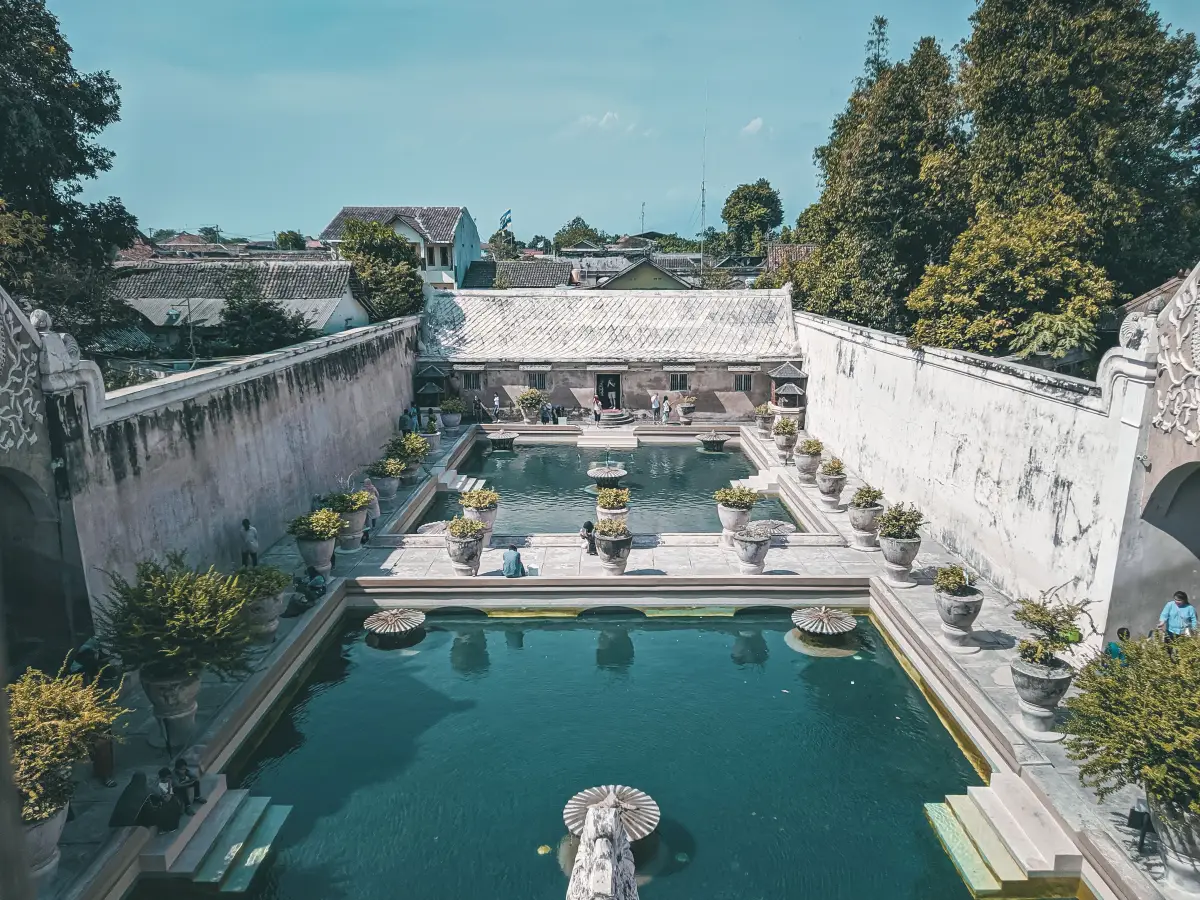
The central bathing area, known officially as Umbul Pasiraman or Umbul Binangun, is the most completely restored section of the estate. Enclosed by high plaster walls, the courtyard is divided into three distinct pools filled with clear, turquoise water fed by dragon-headed fountains:
Located a short walk through subterranean brick tunnels, Sumur Gumuling is one of the most distinctive architectural heritage sites in Central Java.
Sumur Gumuling is a two-story circular underground building that historically functioned as a secret mosque (masjid bawah tanah). Its architecture features a central open-air circular skylight beneath which five raised stone staircases converge over a central well. These five staircases symbolically represent the five pillars of Islam.
Because traditional electronic speakers did not exist in the 18th century, the thick, windowless circular walls were engineered to provide natural acoustic resonance, allowing the imam’s voice to echo clearly through the surrounding prayer niches during services.
If you want to preserve the structural integrity of Sumur Gumuling, local heritage authorities occasionally manage visitor flow or restrict access to the inner staircases during restoration assessments. Check current access notices at the ticket counter upon arrival.
Connecting Sumur Gumuling to the wider estate is a series of subterranean tunnels built from thick brickwork and volcanic ash mortar. Historically, these passages allowed the Sultan and royal attendants to move securely between the Kraton, the meditation chambers, and the outer defense perimeters without being observed from above. Today, walking through these cool, atmospheric tunnels offers relief from the tropical heat outside.
As you navigate the complex, pay close attention to the stone gateways and decorative relief carvings:
Because Taman Sari served as a private royal retreat, it has long generated local folklore and romanticized storytelling. To understand the site deeply, it is helpful to distinguish documented history from popular tourism legends.
| Aspect | Popular Tourism Legend | Historical & Architectural Context |
| The Bathing Pools | Legends claim the Sultan stood atop the tower and threw a flower into the pool below; whichever concubine caught it was chosen for the day. | While the Sultan did observe the grounds from the tower, the complex was primarily an organized royal residential zone with strict court etiquette, changing rooms, and ceremonial bathing routines. |
| Secret Escape Tunnels | Folk stories claim the underground tunnels extended miles beneath Yogyakarta all the way to the Indian Ocean (Pantai Selatan) to meet the mythical sea goddess Nyai Roro Kidul. | Archaeological surveys show the tunnels were tactical passages connecting the Kraton, Sumur Gumuling, and outer defensive walls—not multi-mile subterranean highways to the coast. |
| Underground Mosque Acoustics | Local lore attributes the echo inside Sumur Gumuling to mystical spiritual energy. | The sound resonance is an intentional feat of Javanese architectural acoustics, using thick circular masonry and domed geometry to amplify the human voice. |
Taman Sari is located in the Patehan district within the historic walled Kraton precinct (Kota Cagar Budaya) of central Yogyakarta, Special Region of Yogyakarta, Central Java, Indonesia.
It sits approximately:
Because of its central location within Yogyakarta, reaching Taman Sari is straightforward via several transport modes:
Note: Factual details such as entrance rates and operating schedules are subject to periodic changes by the Yogyakarta Cultural Office (Dinas Kebudayaan). It is advisable to confirm details locally before visiting.
| Parameter | Details / Official Information |
| Official Address | Jl. Taman Sari No. 42, Patehan, Keraton, Kota Yogyakarta, DI Yogyakarta 55132 |
| Opening Hours | Open daily from 09:00 AM to 03:00 PM (WIB) |
| Domestic Visitor Ticket | ~IDR 15,000 per person |
| Foreign Visitor Ticket | ~IDR 25,000 per person |
| Professional Camera Fee | ~IDR 3,000 (applies to DSLR / mirrorless cameras) |
| Local Community Guide | ~IDR 30,000 – 50,000 (optional fee paid directly to local guide) |
Depending on your travel style and interest in historical architecture, consider these three visit scenarios:
Taman Sari is widely considered one of the most rewarding cultural stops in Yogyakarta, provided you approach it with the right context.
Taman Sari’s value lies not in flawless preservation, but in its survival as a living ruin. The fragments that remain allow travelers to step back in time and reconstruct the quiet grandeur of Javanese royal life inside 18th-century Yogyakarta.